|
Thomas Penrose's Bamboo Fly Rod Pages |
Making a Split Cane Fly Rod: |
|
|
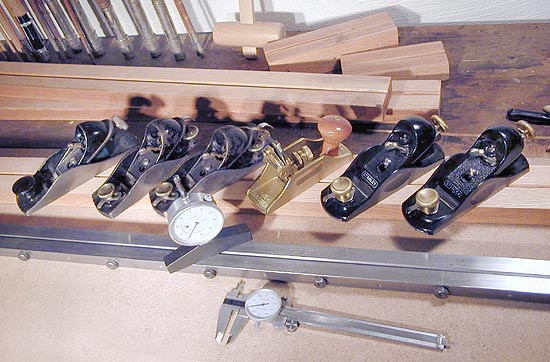
| Pictured above are most of the tools that are used for making split cane fly rods. Included in this photo are block planes, a scraper plane, splicing blocks, dial calipers, a dial indicator depth gauge, and three different types of planing forms for preliminary, secondary, and final planing. |
|
|
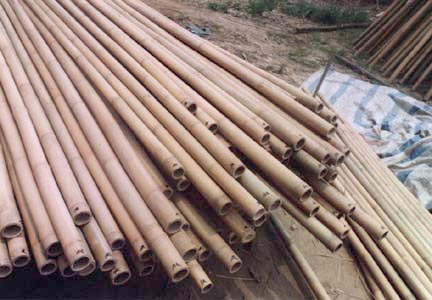
Culms
of 2" diameter Tonkin cane. The protruding rings that occur on
bamboo are called "nodes", and require quite a bit of work
to flatten out before the bamboo can be used to make a rod (this image
courtesy of Andy Royer). |
|
|
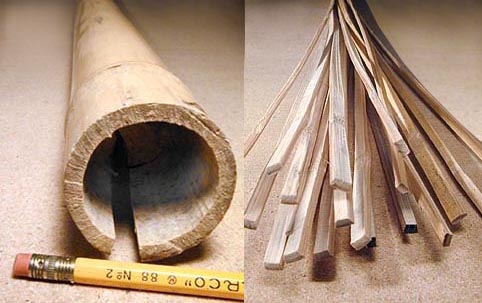
A 6' long culm of Tonkin cane, before and after being split into strips. |
|
|
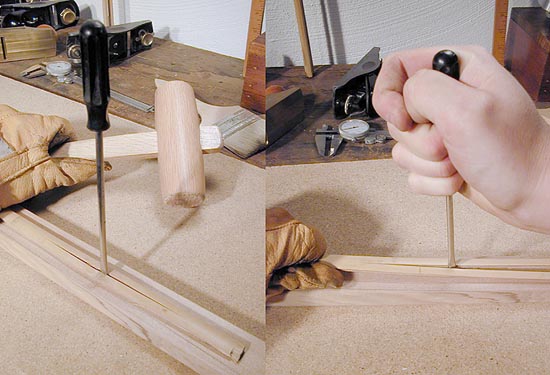
This image shows the actual splitting process. A standard screwdriver with a sharpened blade is driven into a cane strip, and then the gloved hand forces the strip into the sharpened edge of the screwdriver blade, thus splitting the strip down its length into two narrower pieces. With experience one learns to steer the split so that it does not veer off course. |
|
|
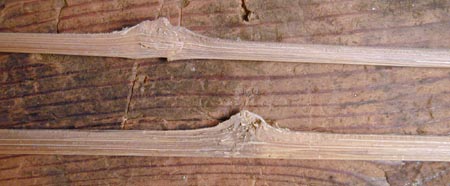
| Some freshly split strips of Tonkin cane. The protrusions are the remains of nodal diaphragms, which occur both inside and outside the bamboo stalk at each node location. They will be mostly removed using a plane and a hand file, and then heat and pressure will be applied to flatten any remaining bumps. |
|
|
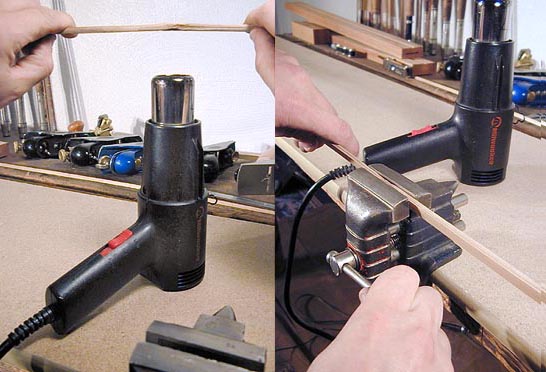
| Heating the node area with a heat gun to soften the cane. After it is sufficiently heated the strip is firmly clamped in a vise to flatten the node area as it cools. In the past alcohol burning lamps were used to heat the cane. |
|
|
| A strip of cane being planed in the preliminary planing form. The approximately 82° angle of the groove in this wooden form helps to start the first 60° angle on the bamboo strip as it is planed. After this 60° angle is created, the strip will be placed into a second wooden planing form that has a 60° groove in it. |
|
|
| A strip in the 60° groove of the secondary planing form. Planing in this form will make the strips become equilateral triangles in section. |
|
|
Checking the accuracy of the 60° angles using a center gauge (image on left). After completing the secondary stage of rough planing the ends of the strips have the equilateral triangle shape that enables them to nest together to form a rod that is hexagonal. They will next be bound together with string and placed in a heat treating oven that will dry, straighten, and temper them. Note that the side of each strip that faces out still has the original enamel layer that serves as the protective natural coating on the exterior of the bamboo stalk. The side of the strips that have this coating is never planed, since the bamboo plant's most elastic fibers lie just underneath this thin enamel layer. The enamel will, however, be sanded off with fine grit sandpaper in the last stages of the rod's creation. |
|
|
| The six untapered triangular strips bound together with string (top image), forming the familiar hexagonal cross section that is typical of bamboo fishing rods. The string binding will enable the strips to heat cure in a straightened position, thus removing most of the kinks that each strip may have originally had. Most importantly, heating the strips in the 6' long oven (lower image) drives out excess moisture, and stiffens the cane somewhat. Many rodmakers believe that placing the rod section in an iron pipe that is then heated with a blow torch serves this function as well as a more expensive oven does. |
|
|
| After heat treating, the bamboo strips will be tapered on a set of adjustable planing forms made from two steel bars (adjustable wooden forms can also be used for final planing). The beveled edges of the bars create a 60° groove down the center of the form that is adjusted in depth by tightening or loosening bolts that draw together or push apart the two sides of the form. The depth of the groove at each point along the length of the planing form is what determines how much the strips will taper from the large butt end of the rod to the smaller tip end. This adjustment is done on the planing forms using the pictured dial indicator depth gauge. There are an infinite number of possible rod tapers that could be used, and to a great extent being a good rod maker involves understanding how different taper designs effect the casting performance of any given rod. |
|
|
The taper being planed into one of the bamboo strips using the steel planing forms and a block plane. The side of the form shown is for planing the larger diameter butt section of the rod. The other side of the form has a shallower groove and is used for planing the tip section. |
|
|
| The strips sometimes tend to tear at the irregularly grained node areas during planing. To smooth these areas out a scraper plane is used. Scraper planes are also often used to remove the last few thousandths of an inch of material to make the strips flush with the top surface of the steel planing form. Inexpensive hand held scraping blades will also work well for rod making. A very thin spline for a tip section is being shown in the forms in this image. |
|
|
| The bamboo strips being bound in a Garrison-style rod binding machine. This is a simple yet ingenious mechanism that binds the strips tightly together when they are glued, which helps to make the glue joints between each strip invisible. However, it is also possible to do a good binding job by hand, without the aid of a binding machine. |
|
|
A close-up of the binder. |
|
|
| The glued strips after having gone through the binder two times (once to apply a clockwise wrap of thread, and again to apply a counterclockwise wrap). Note the excess glue coating the rod blank. This will be sanded away in the next stage. |
|
|
The completed 2 tip rod blank after being sanded with fine grit sandpaper to remove the leftover glue and the cane's natural enamel layer |
|
|
A completed tip section resting on the steel planing form. This end of the tip section is 74 thousandths of an inch in thickness. Each of the six triangular splines it is composed of are 37 thousandths of an inch thick. |
|
|
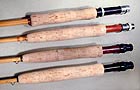
A finished 8' two-piece (three tips) 6 wt. rod. |
End
| For more detailed information on cane rod making, obtain one (or all) of the following books: |
| A Master's Guide to Building A Bamboo Fly Rod. Everett Garrison with Hoagy B. Carmichael. Martha's Glen Publishing Co. [1977] |
| Handcrafting Bamboo Fly Rods. Wayne Cattanach. Privately published [1992] |
| How to Make Bamboo Fly Rods. George W. Barnes. Winchester Press [1977] |
This site created and maintained by Thomas Penrose
All images and text copyrighted ©Thomas Penrose 1997, 2001